
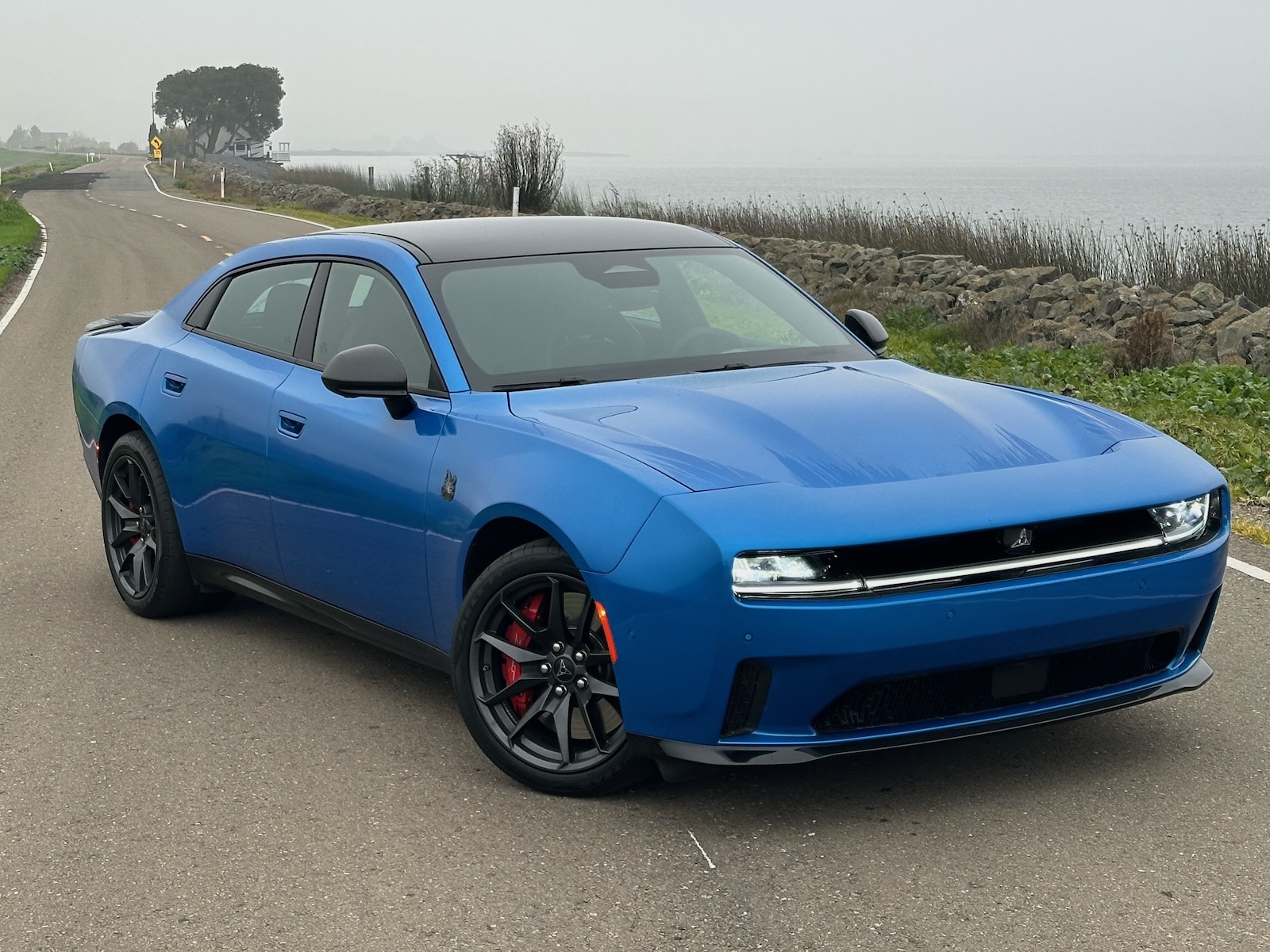
Dodge faces plenty of struggles as a brand, including gaining the acceptance by muscle car mavens of the all-electric 2026 Dodge Charger Daytona.
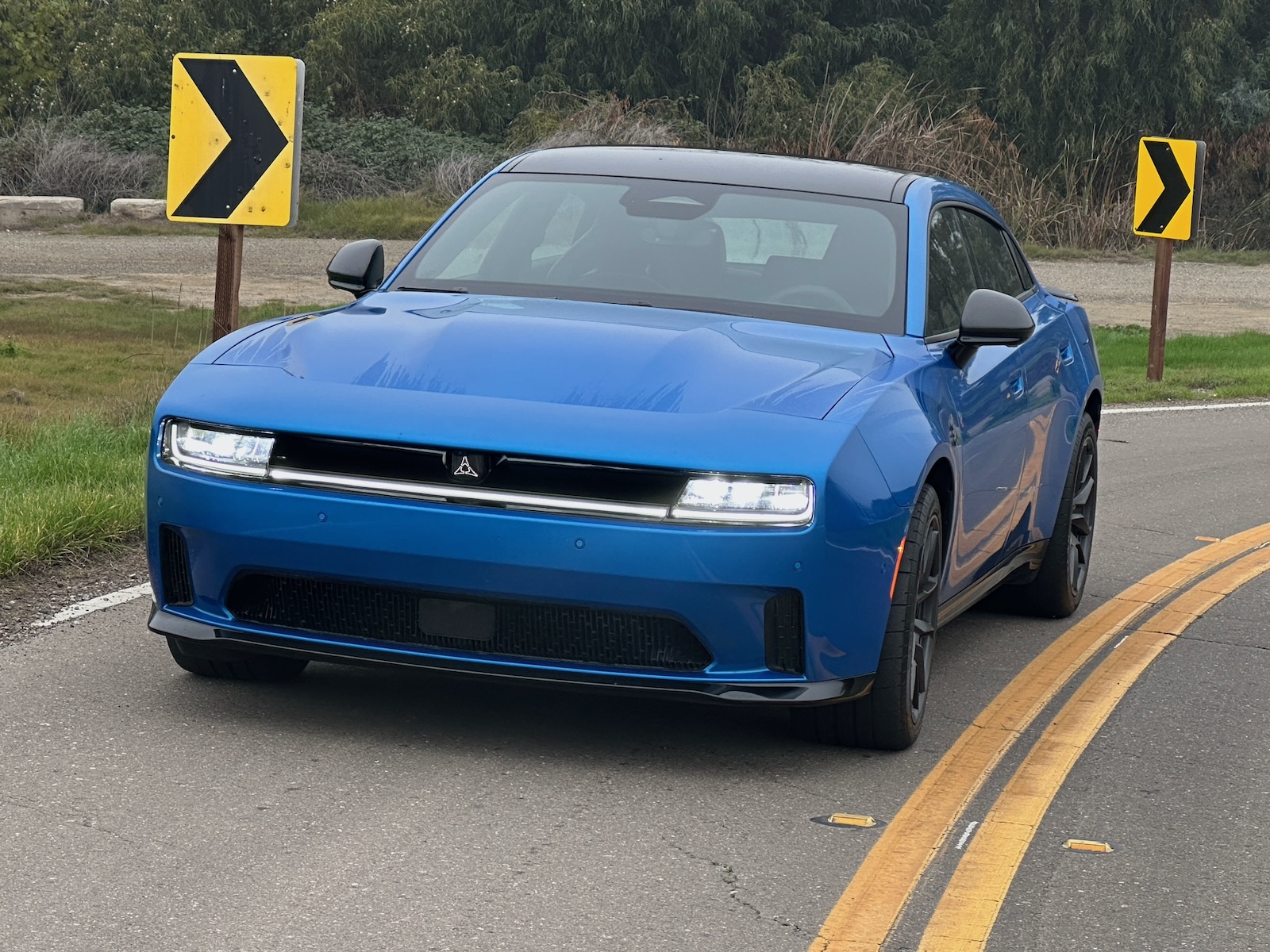
The 2026 Dodge Charger Daytona gives the brand a vehicle to rally around.
While the idea of an electric muscle car might sound antithetical, of late Dodge has made its name pushing everything it touches far beyond the pale. Therefore, it should come as no surprise that the Dodge EV is also way over the top. But is it enough to finally get “Bubba” to buy into EVs?
Intro
My now defunct Facebook homepage would overflow with vitriol every time I dared sing the praises of an EV. The phrase “glorified golf carts,” was one of the more prominent invectives to be coined whenever I penned a positive review of anything other than an ICE-powered automobile.
What’s more, regardless of the logic upon which my praise was founded, deeply ingrained prejudices entombed the minds of my detractors within a tightly secured vault of bias.
Given the vast majority of those people were muscle car fans, it came as a genuine surprise when Dodge announced the eighth generation Charger would be an EV-only offering when it was introduced back in 2024. However, sleek of line and possessing more than enough giddyup to outrun a Hellcat, the 2026 Dodge Charger Daytona Scat Pack with which I spent a late November week was truly an eye-opening experience. If anything had a chance of silencing detractors, this car would definitely be it.
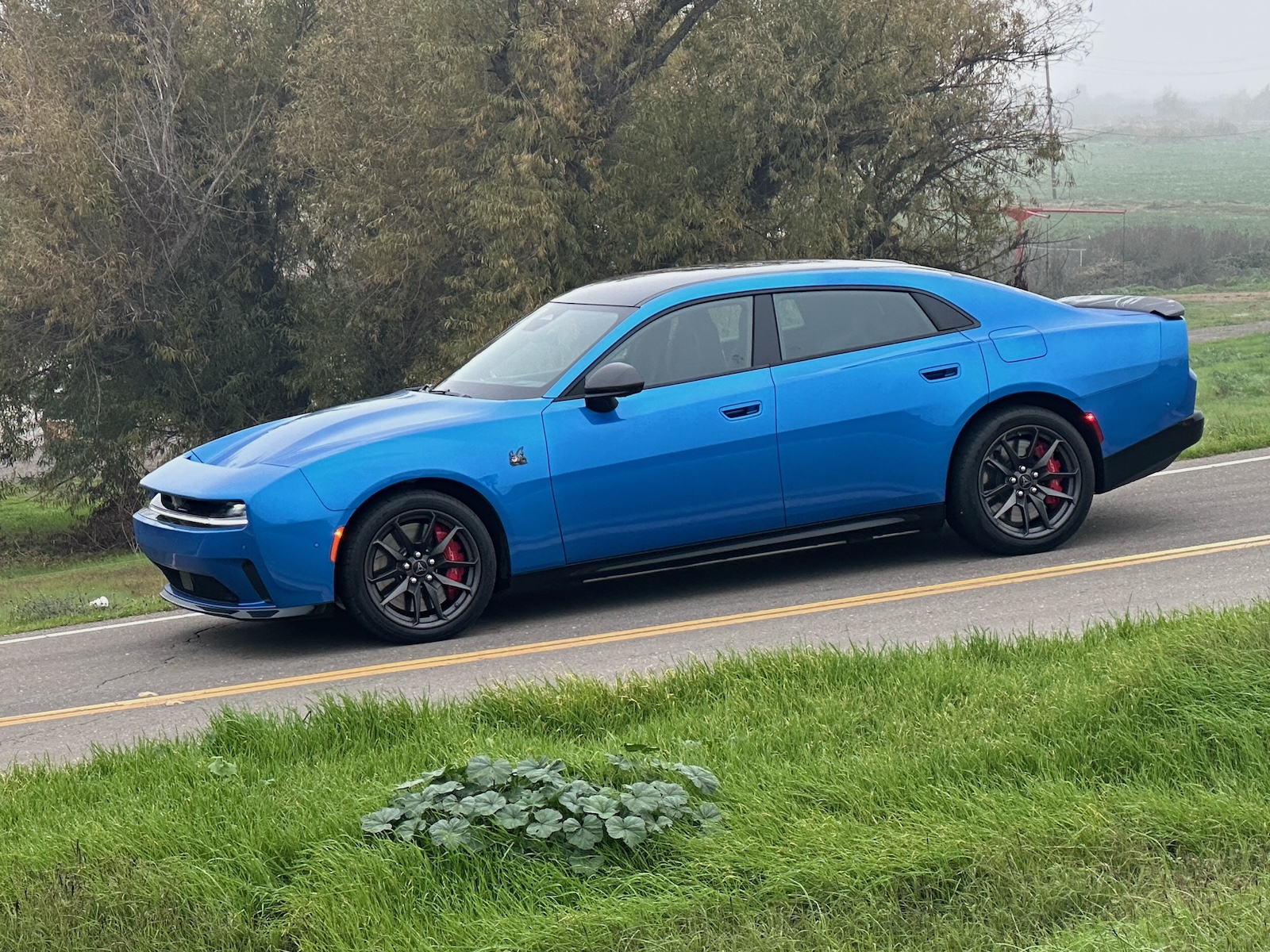
Sleek and powerful enough to outrun a Hellcat, the 2026 Dodge Charger Daytona Scat Pack was truly an eye-opening experience.
All of the muscle car cues were there; chief among them was its outsized styling that screamed, “I will run off and leave anything that dares to line up next to me.” And believe me when I say that was not an idle boast. However it’s still an EV, and powerful though it may be, the electrified Charger’s future appears rather bleak — especially given the fact that Federal support for EVs has all but evaporated.
Powertrains and Fuel Economy
A pair of 400-volt G2500 electric motors were harnessed to endow “my” Charger with what could only be termed prodigious propulsion (please forgive the alliteration). Apportioned one apiece to each set of wheels — front and rear — those motors also endowed the Charger with all-wheel drive.
A 15-second boost of 80-horsepower could be unleashed whenever I pressed the “Power Shot” button on the steering wheel. This gave the Charger a total of 670 hp with which to work. A front/rear offset one-speed gearbox handled transmission duties.
Electricity was stored in a 94-kWh battery pack. Dodge quotes a maximum range of 241 miles on a full charge. The EPA estimates 223, the best I saw was 195. Using a 350-kWh EVgo fast charger, I experienced a charging time of just over an hour to get the Dodge EV to a full charge from 80% depletion.
Interior Accommodations
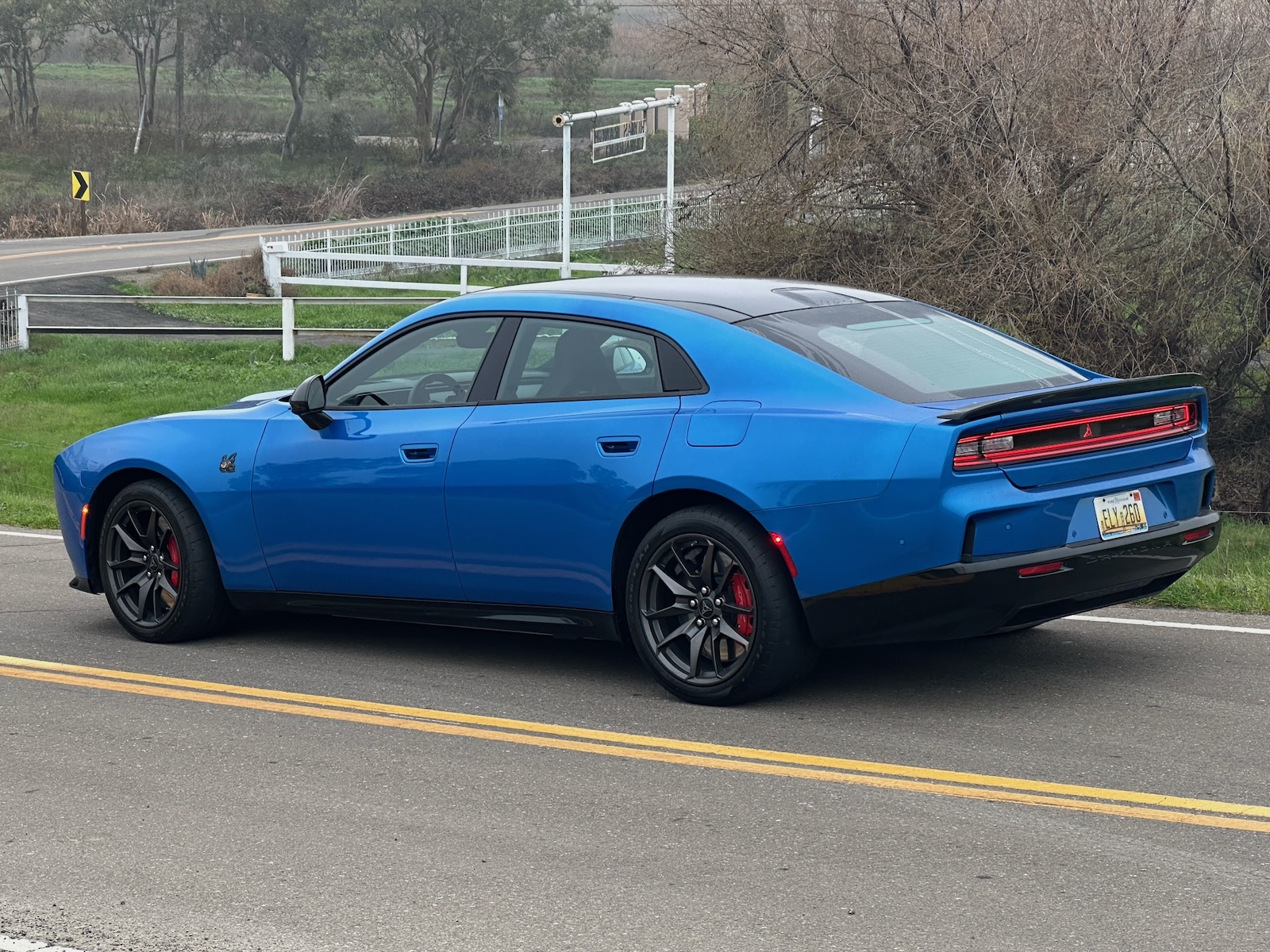
Electricity was stored in a 94-kWh battery pack. Dodge quotes a maximum range of 241 miles on a full charge.
Seating four grown folks in the Charger was no problem. Even the person who drew the short straw, and was forced to sit behind 6’1” me, had no legroom complaints.
Upholstered in leatherette and suede, the seats provided more than ample support — along with enough “grippiness” to keep everyone in place when I zealously demonstrated the big four-door’s performance potential. And yes, I did so for everyone I could coax into getting into the Dodge with me. (Now that I think about it, that could also account for the consistent 195 miles of range the Dodge achieved under my stewardship.)
One of the things people sometimes forget is muscle cars were derived from mainstream models, designed to serve as daily drivers. In that regard, the Charger Daytona offered an abundance of storage.
This included some 23 cubic feet behind the back seat and a 1.5-cubic foot compartment under the hood. It was also a hatchback, which made the sedan reasonably utilitarian.
The interior designers included some nice homages to Chargers of yore, the most prominent of which was the “pistol grip” shifter on the center console. Also housed there was the power on/off button and a wireless phone charging pad. Driver selectable ambient lighting was a welcomed touch as well.
Comfort, Convenience & Safety Tech
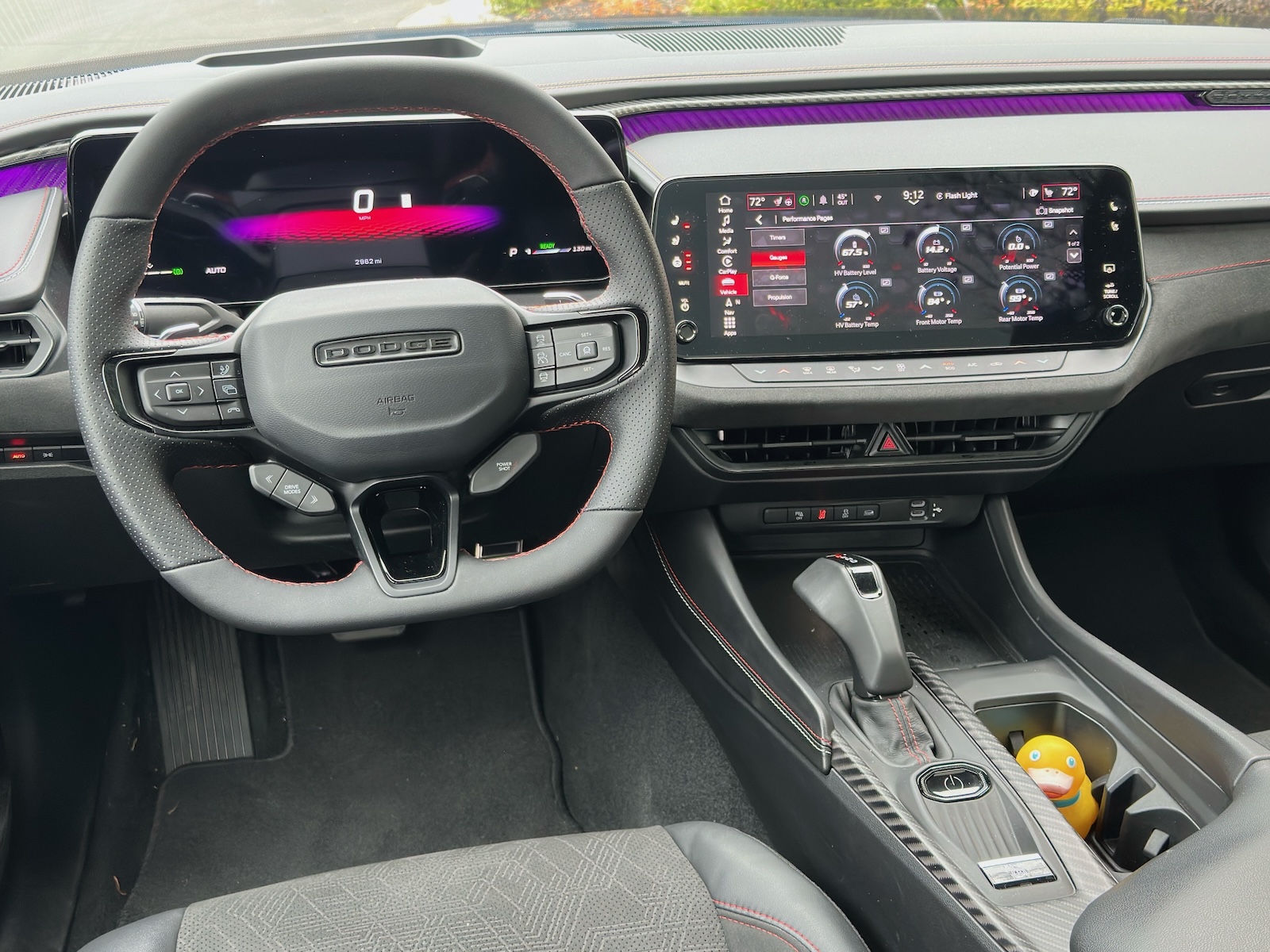
Rooted firmly in 21st century aesthetics, the cockpit was dominated by a pair of digital monitors, measuring 10.3 and 16 inches diagonally.
Rooted firmly in 21st century aesthetics, the cockpit was dominated by a pair of digital monitors. Measuring 10.3 and 16 inches diagonally, they were two of the busiest screens I have seen fitted to a passenger car in my life. Should I ever have occasion to converse with the Dodge’s product planners, I will tell them there is such a thing as too much information. My eyes frantically wandered around the infotainment screen trying to take it all in.
With that said, I was pleased to find old-school-like performance gauges buried within the confines of the infotainment screen once I got over the initial shock of it all. That touchscreen monitor also provided control over every aspect of the Charger Daytona’s performance parameters, allowing me to adjust suspension, steering and throttle responses.
The screen’s performance pages displayed timers, ancillary gauges and g-force readouts — as well as granting the ability to store the data they displayed for future reference. Settings for line lock, donuts, drifting and launch control were accompanied by drag racing, track and sport modes.
Selecting each of the latter settings altered the response of what the Dodge Boys refer to as their “Fratzonic chambered exhaust” solution.
Designed to replicate the old-school rumble of the marque’s august Hemi V8s, the amplified speaker fooled a few of my passengers into thinking the Charger was harboring an internal combustion engine under that massive hood. In fact, they remained unconvinced until I switched the speaker off and the Charger pulled just as hard without making a sound.

Upholstered in leatherette and suede, the seats provided more than ample support — along with enough “grippiness” to keep everyone in place.
Driving Impressions
This brings me to how the Charger went about the business of being a muscle car. First of all, let me say that amped-up bumblebee badge festooning the front fenders ain’t no hollow boast. The Charger Daytona does indeed “scat” when given free rein. In fact, one of my friends commented, “I don’t know when I’ve ever been in a car that would go this fast this soon.”
The Scat Pack equipped Charger didn’t just accelerate; it LUNGED forward when the Power Shot button was employed in conjunction the application of full throttle. I consistently saw zero to 60 times of just over three seconds. What’s more, the Charger would routinely hit 100 mph in the time it takes a lot of cars to get to 60. According to the folks at Dodge, the Charger Daytona Scat Pack will do 11.5-second quarters and replicate them 10 times on a single charge.
By the way, the mechanical bits comprising the Track Package include Brembo brakes, an adjustable damping competition suspension system and 20-inch wheels wearing a set of 305/35 Goodyear Eagle F1s. On the street, road holding was more like that of a grand tourer than a sports car. Which, I suppose was to be expected for something that big weighing just over 5,800 pounds.
Additionally though, ride quality was bit on the unsettled side. The Charger tended to dance around on its suspension more than I would have preferred. While the Dodge never made me doubt its grip, that planted feeling at speed for which I look in a car with this much performance potential wasn’t there.
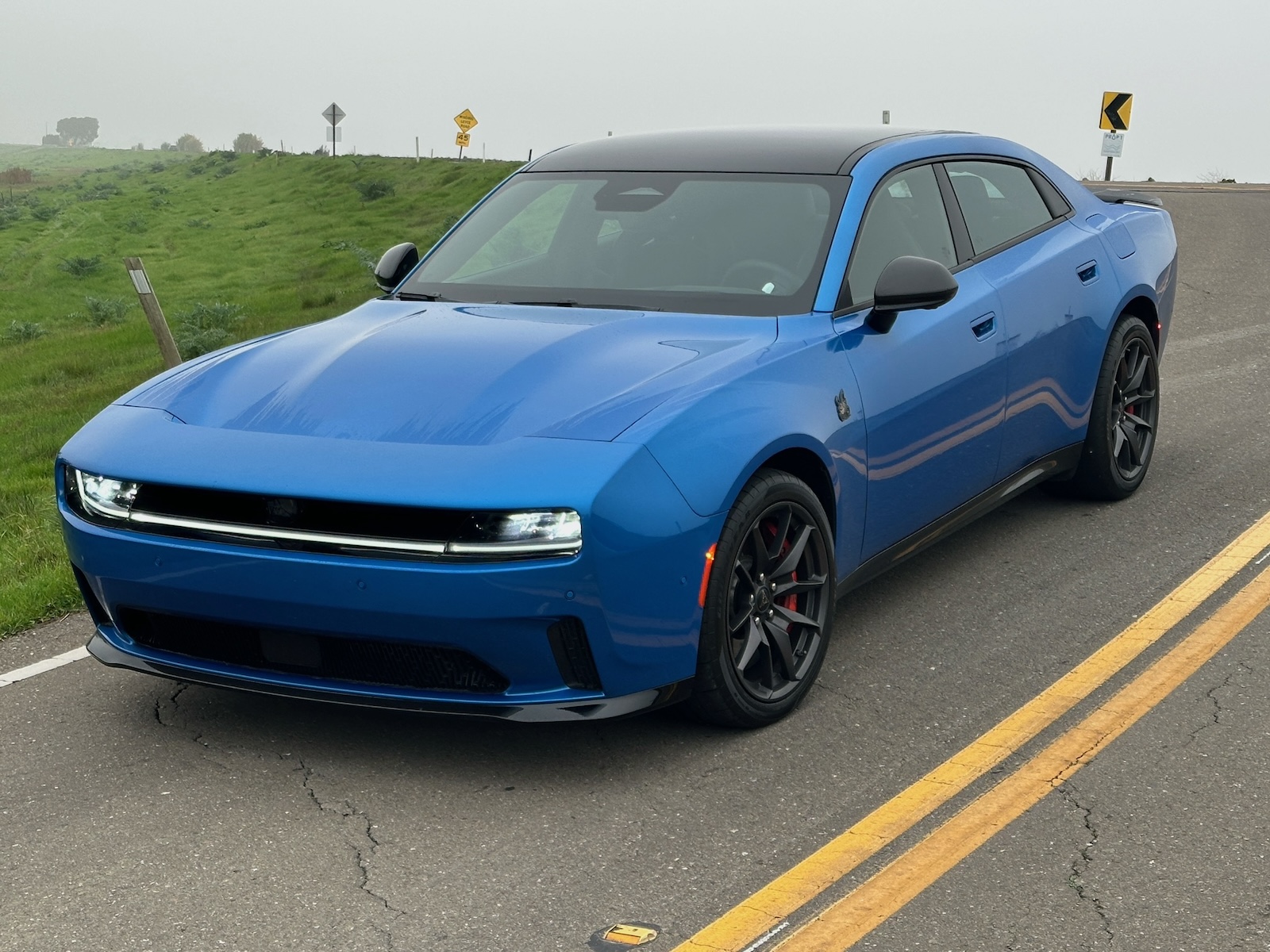
The Charger would routinely hit 100 mph in the time it takes a lot of cars to get to 60.
In Summary
So, are the “Bubbas” going to finally be convinced an EV can be just as satisfying to drive as the gas-burning Chargers and Challengers it was intended to replace? Well, those of you who read between the lines probably noted I said “was” intended to replace. The announcement that a twin-turbocharged straight 6 is on the way has already come. One can also reasonably assume a Hemi V8 powered version is likely to be on the way.
After all, Dodge had already hedged that bet. Pop the hood and it’s easy to see the Charger was designed with to be fitted with an internal combustion engine. Good thing too, because dealers are having so much trouble moving Chargers the only one I’ve ever seen in the “metal” is the one I drove — and the coupe version has been offered for going on two years now.
So yeah, it’s looking like “Bubba” ain’t ready yet. However, it’s also useful to note when Dodge introduced the super-aerodynamic big-winged 1969 Daytona (upon which the 1970 Plymouth Superbird was subsequently based), dealers weren’t moving too many of those either. They are now highly sought-after collectibles.
So, is the 2026 Dodge Charger Daytona Scat Pack Track Package destined to one day be as revered as its 20th century forebears? Only time will tell. Right now though, “Bubba” ain’t bitin’. Pricing starts $61,995. Price as tested for the example I drove was $70,375.


0 Comments