
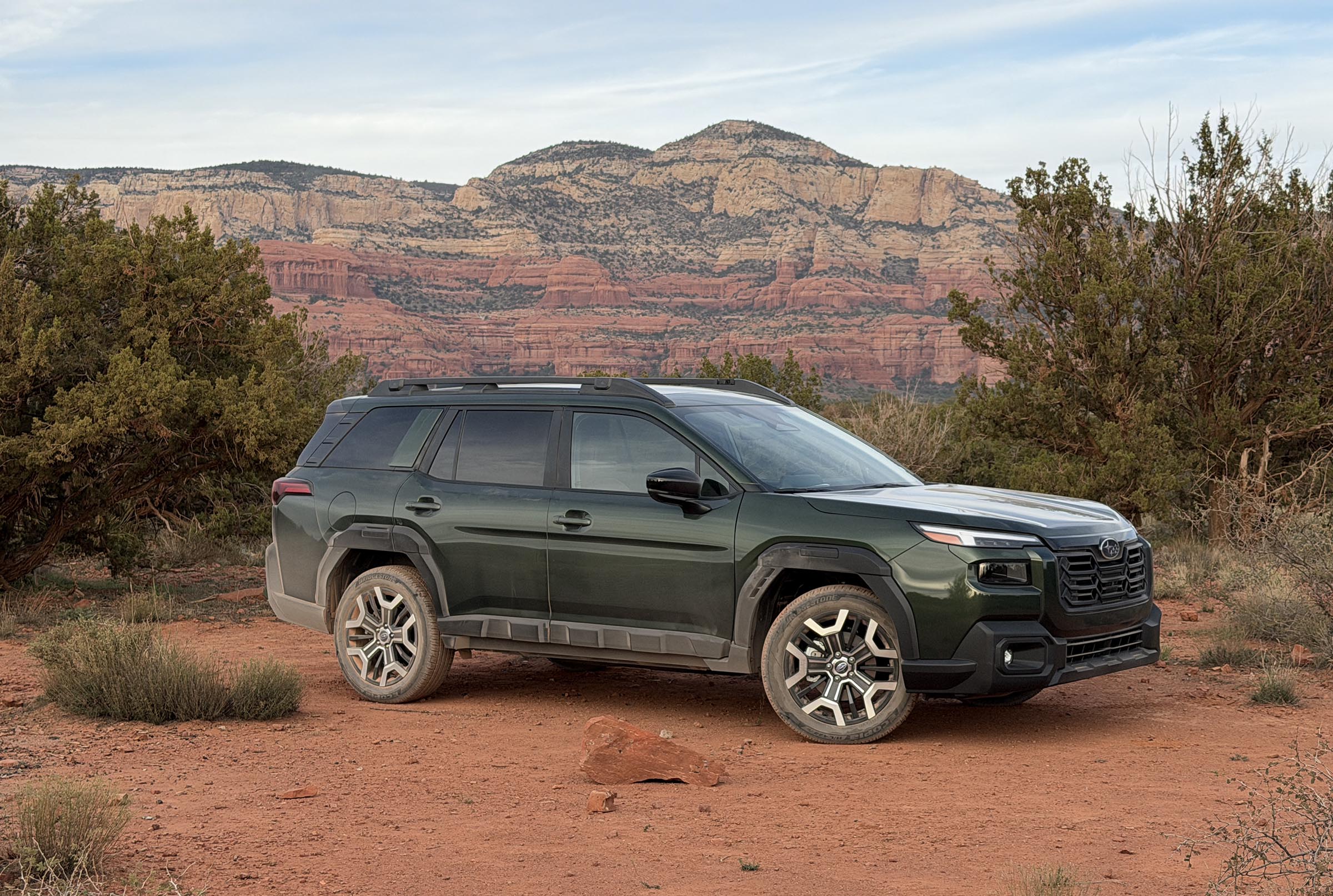
Little Subaru is a brand that has frequently surprised its bigger rivals and it does it again as the top-ranked marque in the 2026 Consumer Reports Auto Brand Report Card, besting manufacturers like Toyota, Honda and second-ranked BMW. That was one of the surprises in this year’s study. Headlight.News has more.
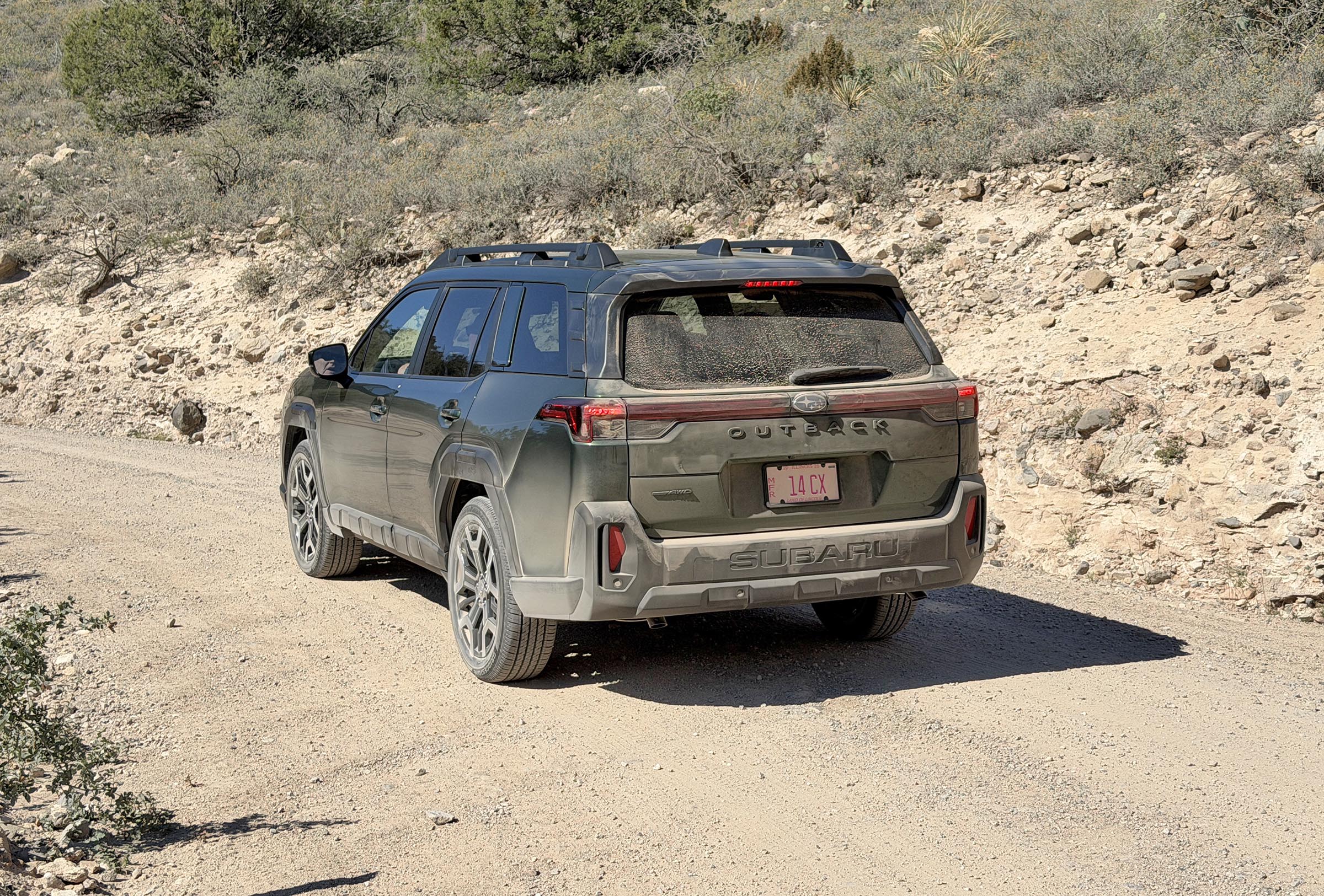
Subaru scored with consumers in terms of reliability, test scores and owner satisfaction, CR reported.
When you factor in quality, reliability, test scores and owner satisfaction, Subaru came out at the head of the class in the 2026 Consumer Reports Auto Brand Report – though it might not be as big a surprise as that might seem considering Subaru came out tops in 2025 and led the industry for three of the past five years.
Asian brands, in general led the annual study, which is based on surveys taken by 380,000 vehicle owners across the U.S., while domestic American brands largely lagged behind. Europeans, meanwhile, were a mixed bag, with BMW coming in just a hair behind Subaru.
Perhaps the biggest surprise? Hybrid vehicles actually proved more reliable than those solely powered solely by internal combustion engines – though owners reported plenty of problems with most plug-ins and pure EVs.
Who’s hot…
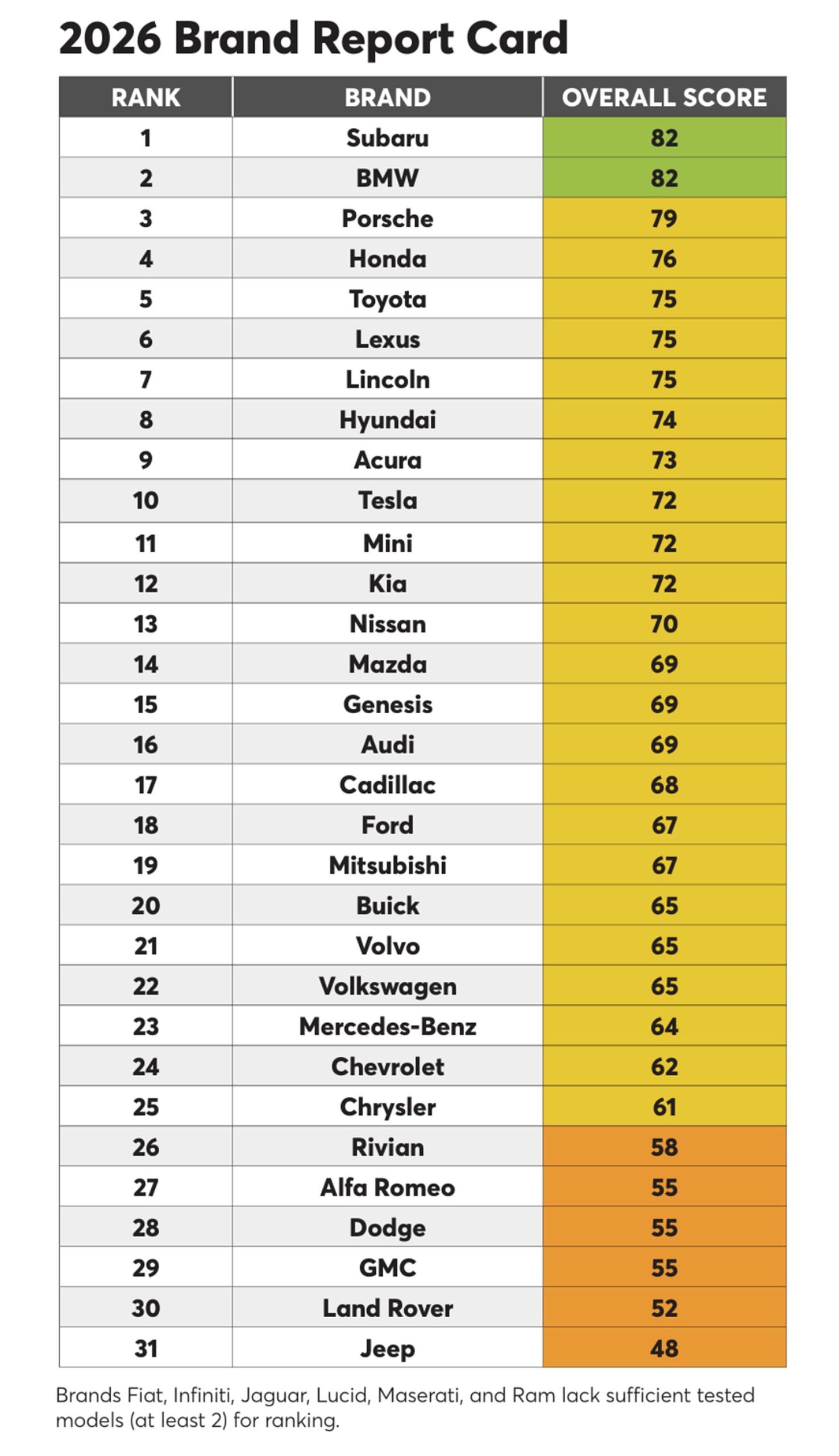 Since Consumer Reports says it considers “road-test scores, predicted reliability and owner satisfaction from survey data, and safety ratings for all tested models from each automaker,” the annual study really delivers what might be considered a brand’s GPA, or grade point average.
By that metric, Subaru was the valedictorian for the second consecutive year with a score of 82. BMW came in a close second, CR noted, a fraction of a point behind.
Going down the list were Porsche, Honda, Toyota, Lexus, Lincoln, Hyundai, Acura and, rounding out the top 10, Tesla. The upstart EV manufacturer made one of the biggest year-over-year jumps, CR noted, largely due to improvements in reliability.
Who’s not
Significantly, the top 10 included six Asian marques – with five Japanese and one Korean – along with two European and two American brands.
Not all the Japanese came out on top, however. Mazda had its troubles, especially in the “reliability category,” suffering from issues with both of its flagship models, the CX-70 and CX-90.
Europeans were a decidedly mixed bag, with strong showings by BMW and Porsche, Audi, Volkswagen and Mercedes-Benz getting grades between what might be considered B- and C-. And then there’s Land Rover which came in second-to-last among the 31 ranked brands.
That left the dubious honor of anchoring the class of 2026 to Jeep with a score of just 48. Domestic brands, as a whole fared poorly, largely dragged down by the low scores of the various Stellantis brands – also including the likes of Chrysler, Alfa Romeo and Dodge – as well as Chevrolet with a score of 62.
More Automotive Consumer News
- Trump Administration Gutting Federal Mileage Standards
- November Vehicle Sales Hit by Rising Prices, Slump in EVs
- Check Out This Week’s Headlight.News Podcast
Reliability
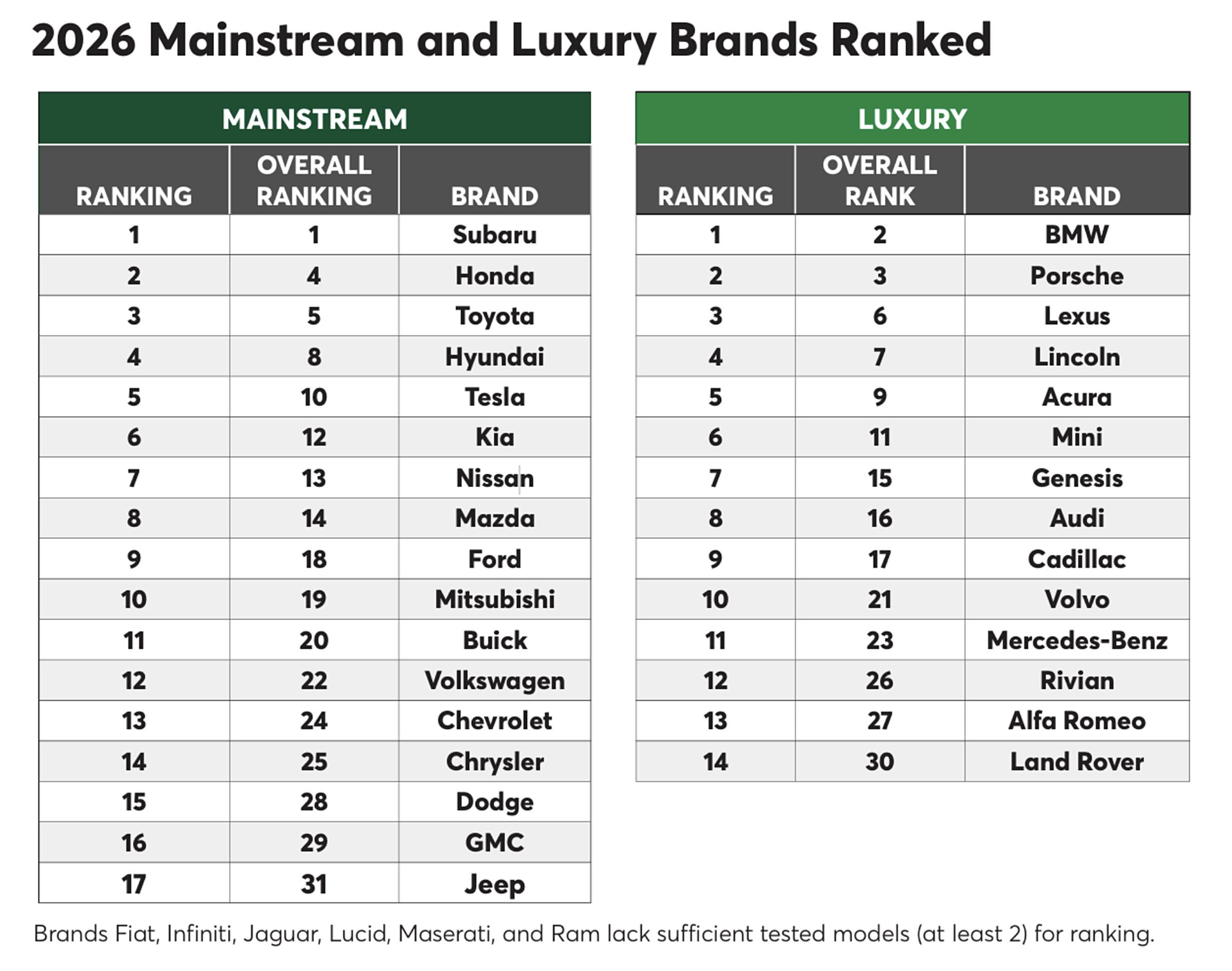 While the overall results of the Auto Brand Report Card typically generate headlines, the most closely watched grade focuses specifically on vehicle reliability. And, here, there are few surprises. At least among mainstream brands, anyway.
Toyota lived up to its long-standing reputation for delivering industry-leading quality and reliability – though Subaru still managed to come in second, just ahead of Toyota’s luxury arm, Lexus. They were followed by Honda, BMW, Nissan, Acura, Buick, Tesla and Kia.
A quick inspection shows that luxury brands are struggling to keep up with the quality and reliability improvements mainstream brands have made in recent years. One reason, according to various analysts: luxury makers often get penalized for problems with all the added features they offer.
Meanwhile, a closer look reveals that owners routinely report problems with all-new and heavily updated products, said Jake Fisher, senior director of auto testing for Consumer Reports. “For reliability-conscious car shoppers, the best bet is to steer clear of newly-introduced or newly-redesigned vehicles in their initial model year, as that’s when they are almost always the most problematic,” he explained.
Hybrids take the lead
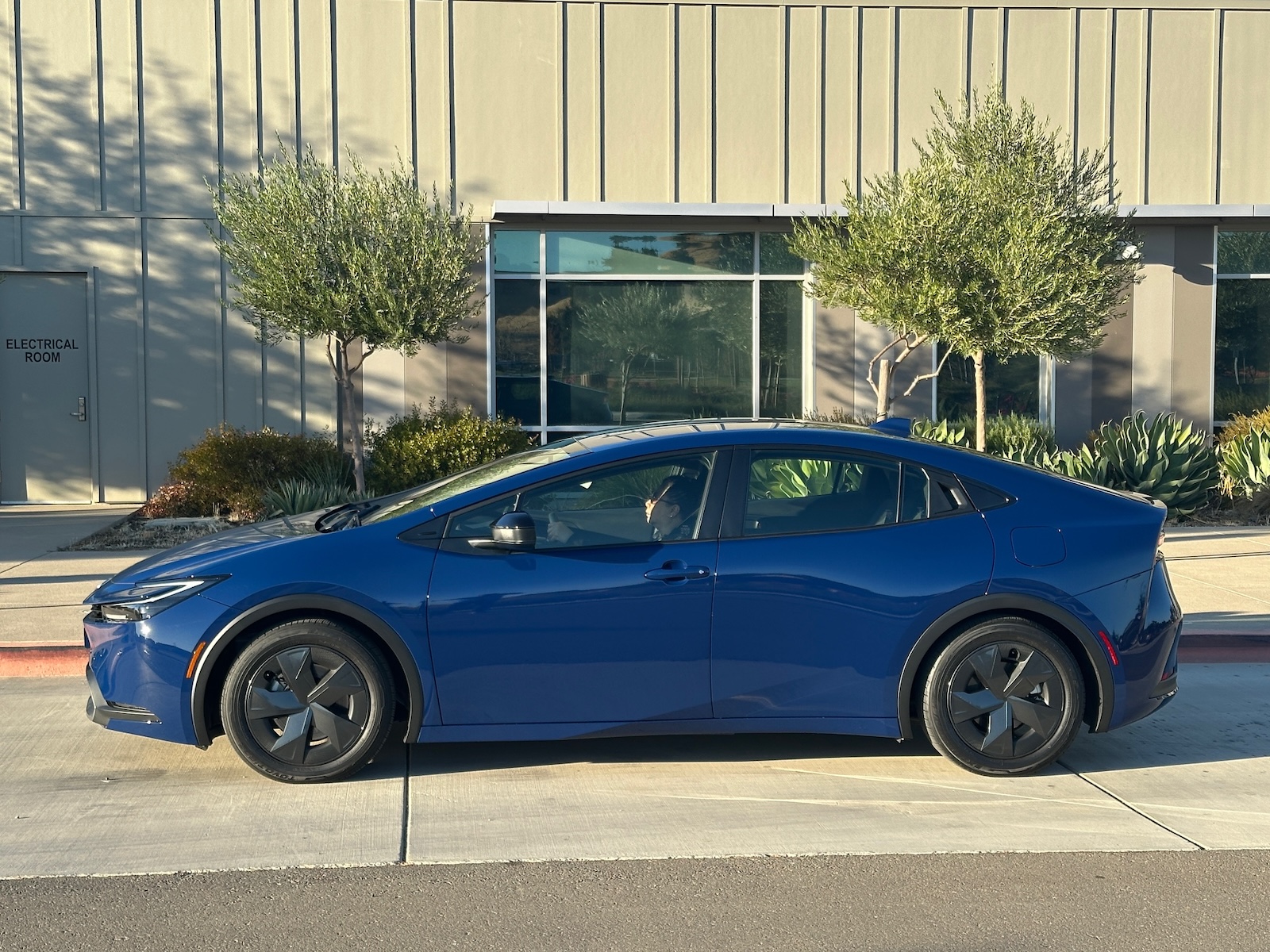
The Toyota Prius is arguably the market’s most familiar hybrid.
Perhaps the biggest surprise for 2026? The strong performance of hybrid models. Conventional hybrids, such as the familiar Toyota Prius, have been gaining ground rapidly, Americans purchasing a record 1.6 million last year – more than one in every 10 new vehicles sold.
And while they add a bit of powertrain complexity, “On average, hybrids have about 15 percent fewer problems than internal combustion engine (ICE) cars,” a summary of the CR Report Card summarized. Among conventional hybrids, it added, “only the Hyundai Sonata Hybrid, Lincoln Nautilus Hybrid, and Mazda CX-50 Hybrid have below-average predicted reliability scores.”
Unfortunately, the news wasn’t nearly so good for other electrified vehicles. The owners surveyed for this year’s report car experienced about 80% more problems with their plug-in hybrids and pure battery-electric vehicles than did owners of ICE models – with EVs and PHVs accounting for seven of the 10 least reliable vehicles. But don’t give up hope if you’re looking for a reliable battery-electric vehicle. Over a dozen EVs from Tesla, Ford, Toyota, Lexus, Subaru and Hyundai ranked average or better in terms of reliability. The Tesla Model Y was the most reliable EV — though the Rivian R1T was rated least reliable.
“With so many newly introduced EVs and PHEVs, along with the still relative newness of the technology, these growing pains were inevitable,” Fisher said. “However, we are seeing evidence in our survey that some EVs are improving as they age, and there are some reliable models available.”

Testa is Mainstream and Mini is Luxury?
Who makes this up?