
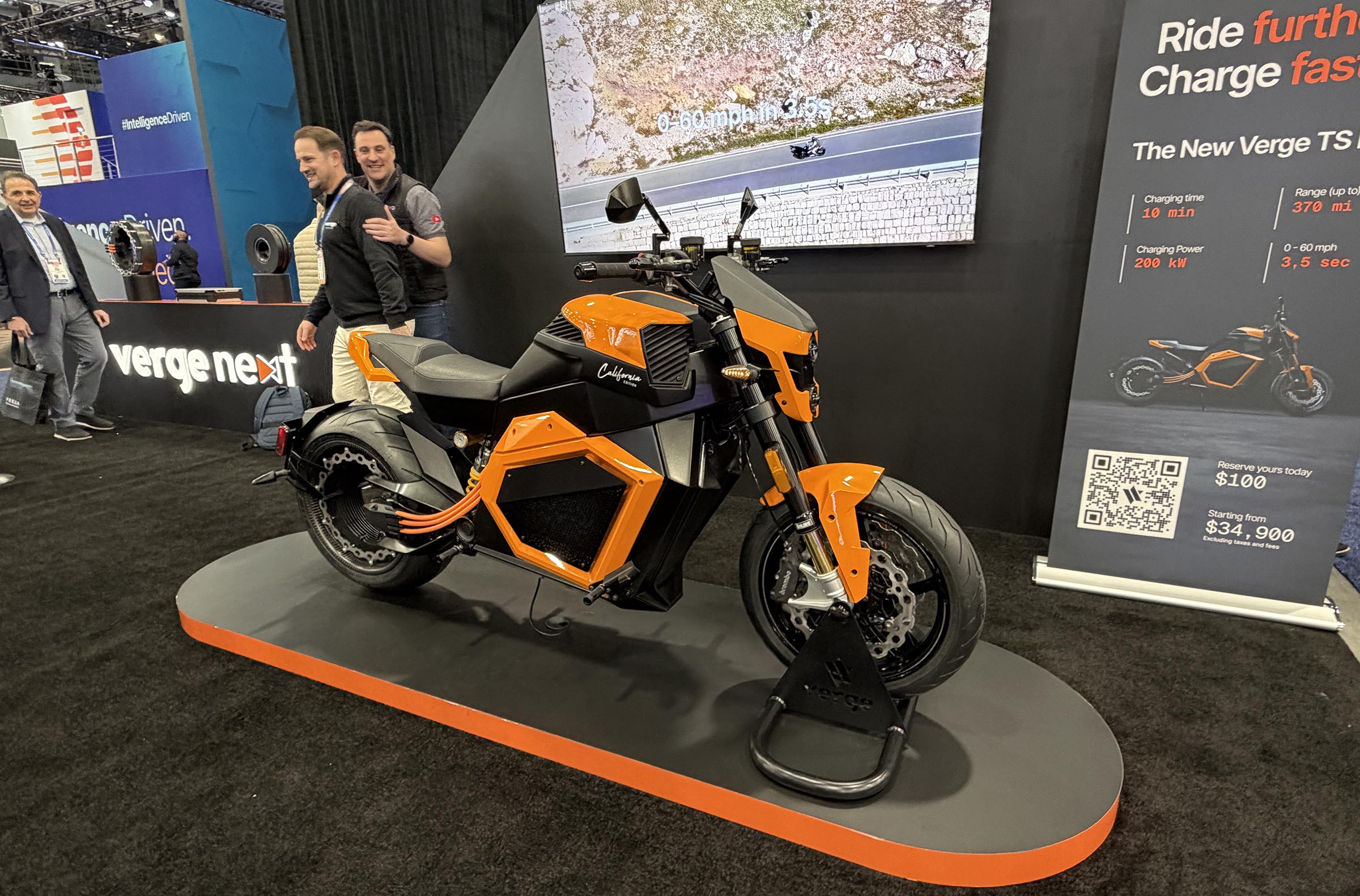
Two small Northern European start-ups are ready to do what even some of the biggest mobility companies in the world haven’t been able to accomplish: bring revolutionary new solid-state batteries into production with the debut of a new motorcycle delivering as much as 370 miles per charge. Are the claims made by Finland’s Verge Motorcycles and Estonian battery supplier Donut Labs too good to be true? Headlight.News has more.
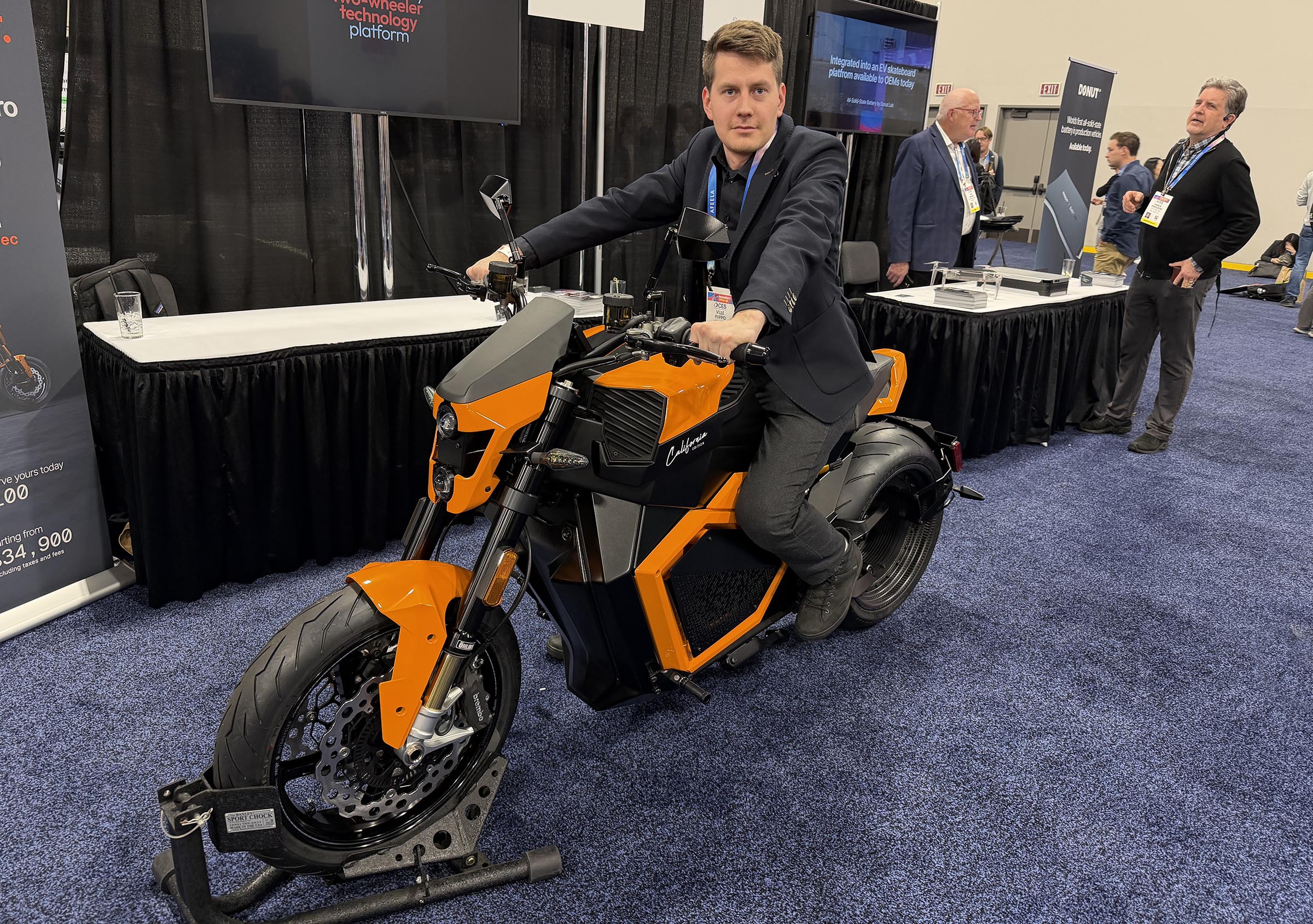
Donut Labs CTO Ville Piipo with the Verge TS Pro e-bike.
For those wandering the sprawling West Hall of the Las Vegas Convention Center earlier this month it would have been easy to walk right by the Verge Motorcycles stand set up during the Consumer Electronics Show. There were hundreds of other, more compelling displays showing off the latest in mobility tech to check out. The Verge stand was little more than a poster board and a bright orange e-bike.
Electric motorcycles have become increasingly common these days, even Harley-Davidson entering the market. But demand is modest, largely due to limited range and high prices. But the bike on display at the Verge stand promised to revolutionize not only the electric motorcycle segment but transportation, in general. Indeed, the technology powering the Verge TS Pro could have a massive impact on virtually everything powered by batteries, from smartphones and watches to grid-level energy storage systems.
Based in Finland, Verge is the first company set to put breakthrough solid-state batteries into commercial application, using cells developed and produced by another small Northern European start-up, Estonian-based Donut Labs. Solid-state batteries, if they actually live up to their hype, will be more powerful, safer, significantly quicker to charge and substantially less expensive than the lithium-ion technology used just about everywhere today.
What’s new
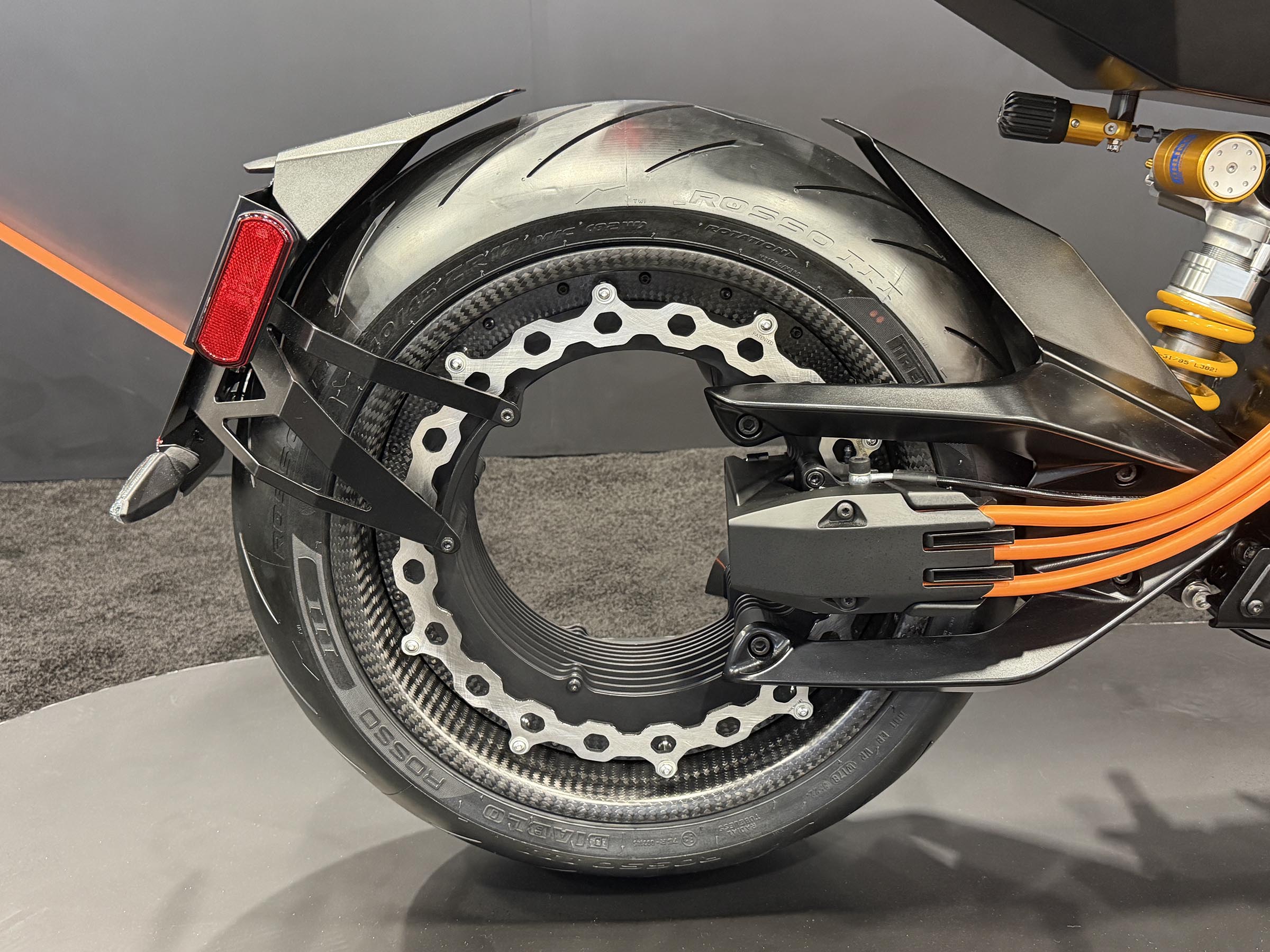
The Verge TS Pro not only uses solid-state batteries but features a hubless electric motor.
“We will no longer make any bikes with lithium ion (batteries),” a spokesman told Headlight.News. “We will only use solid-state,” with the first of the new Verge TS Pro bikes being delivered to customers by the end of the first quarter of 2026.
Even without these new batteries, the bike is a stand-out, using a unique hubless motor built into the rear wheel. There’s no chain or driveshaft. But it’s the switch from lithium-ion to solid-state batteries that comes as the real breakthrough. Verge will offer two optional battery packs, both small enough to tuck inside the TS Pro’s fairing yet big enough that they can offer as much as 370 miles of range, the company claims.
Better yet, it promises charging times of just 10 minutes when plugged into a public charger capable of delivering at least 200 kW of juice – increasingly common these days. And the Verge TS Pro is no scooter. While not the fastest bike on the market it can still launch a rider from 0-60 in a factory-promised 3.5 seconds.
What’s a solid-state battery
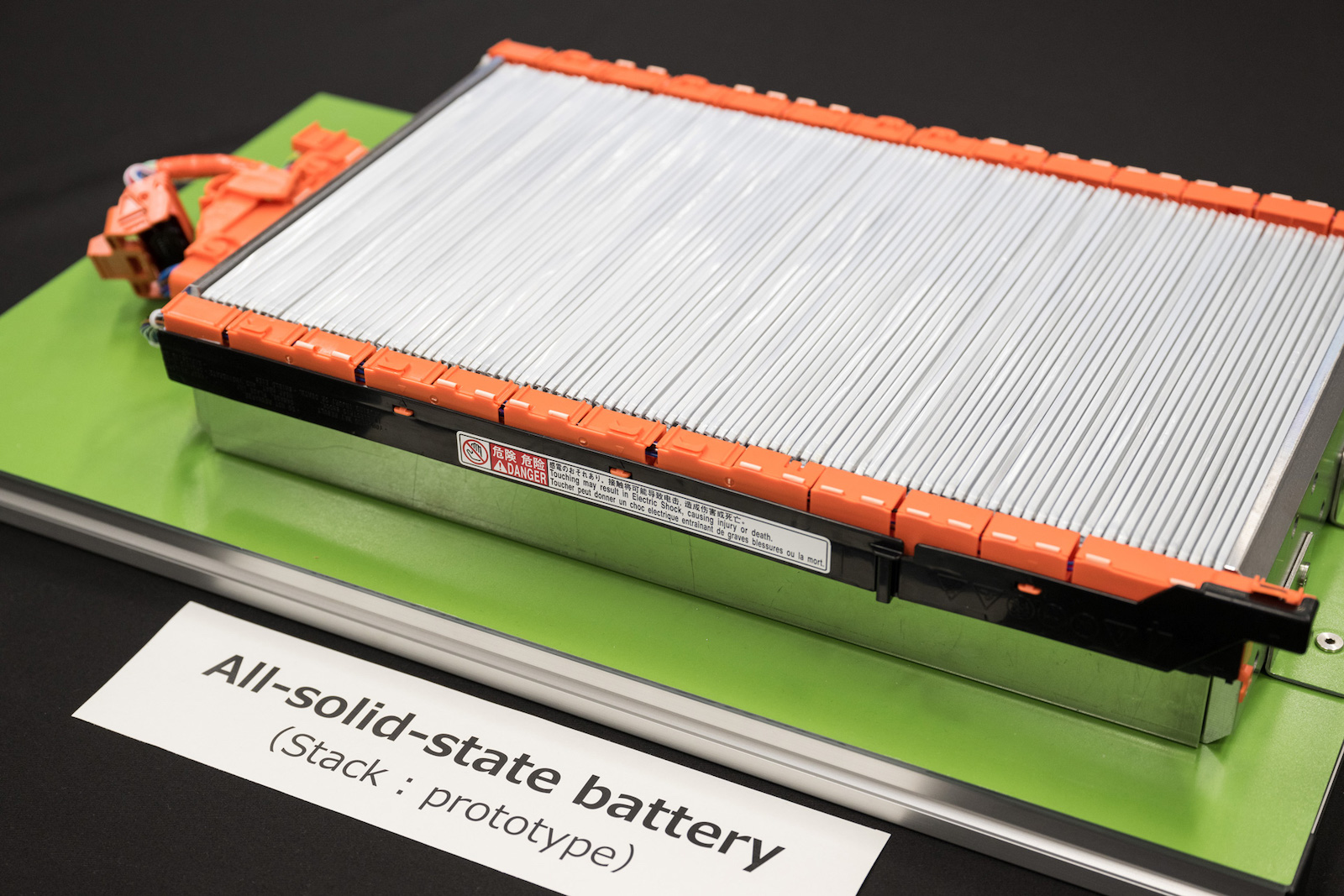
A number of companies are working on solid-state battery technology, including Toyota, a prototype of its cell design shown here.
While the Verge TS Pro is set to become the first commercial application, expect to see the same solid-state technology show up in a variety of other places, according to Ville Piippo, the Chief Technology Officer of Donut Lab. “We are now ready to bring truly exceptional technology to the electric mobility market,” he said. Claiming that, “our battery technology can be used in all types of vehicles, from motorcycles and passenger cars to trucks, robotics and stationary energy storage.”
Think of solid-state cells as the Holy Grail of battery technology. The critical difference between them and more familiar lithium-ion cells is that they eliminate the liquid or goopy gel used as a battery’s electrolyte, replacing it with a solid material. This may not sound like much but it is absolutely transformative, reducing weight and cost, while also eliminating the part of a lithium-ion battery that can cause the biggest problem: thermal runaways that can lead to hard-to-control fires.
In a conversation at CES, Piipo told Headlight.News that Donut’s first production batteries are delivering 400 watt-hours of energy per kilogram. That’s roughly twice what the typical lithium-ion batteries used in today’s EVs can muster, and around 50% more than the top-rated cells from the likes of Tesla and Lucid.
Meanwhile, the Donut Labs CTO claims they’re “practically immortal,” routinely going through 100,000 charge/discharge cycles before showing any sign of degradation. While today’s lithium-ion batteries are lasting far longer than just a few years ago, that’s at least an order of magnitude better – if it proves out in real-world applications. In consumer terms, that would translate into millions of miles of driving without the need to replace the pack.
More EV News
- Climate Change is Real and EVs Work – So, What’s Trump’s Problem
- Volvo Debuts Next EV, the EX60
- Cybertruck Sales Have All But Dried Up
“No reliance on China”

Among other advantages, by replacing today’s flammable liquid electrolyte with a ceramic alternative, solid-state batteries are expected to be fire-resistant.
All of the claims made by Donut Labs and Verge will yet need to be verified, but there are plenty of other reasons to be impressed up front. The cellmaker claims its technology is far less vulnerable to operating temperatures, meaning it should lose less power in cold weather conditions, and be able to charge up nearly as quickly in the midst of a Michigan winter as it would in balmy Florida.
An even bigger selling point: lower costs. Piipo was vague about specifics, partially due to the reality that the company still needs to ramp up production capacity from the small operation it has today. But it will easily beat the $100-plus price for today’s lithium-ion cells, he said. Experts in the battery field see target prices for solid-state targets more in the range of $50-$75 per kilowatt-hour. For a midsize EV with a range of 300 miles, getting 2.5 miles per kWh, that could yield saving of $5,000 or so versus current lithium cells.
Then there’s what could be the most compelling argument from a geopolitical standpoint. “This is completely off China,” said Piipo, “No reliance at all.” While he declined to discuss specific chemistries, the CTO said Donut Labs’ cells do not use lithium and “none of the (other) rare earth metals” required by today’s batteries.
Ramping up production
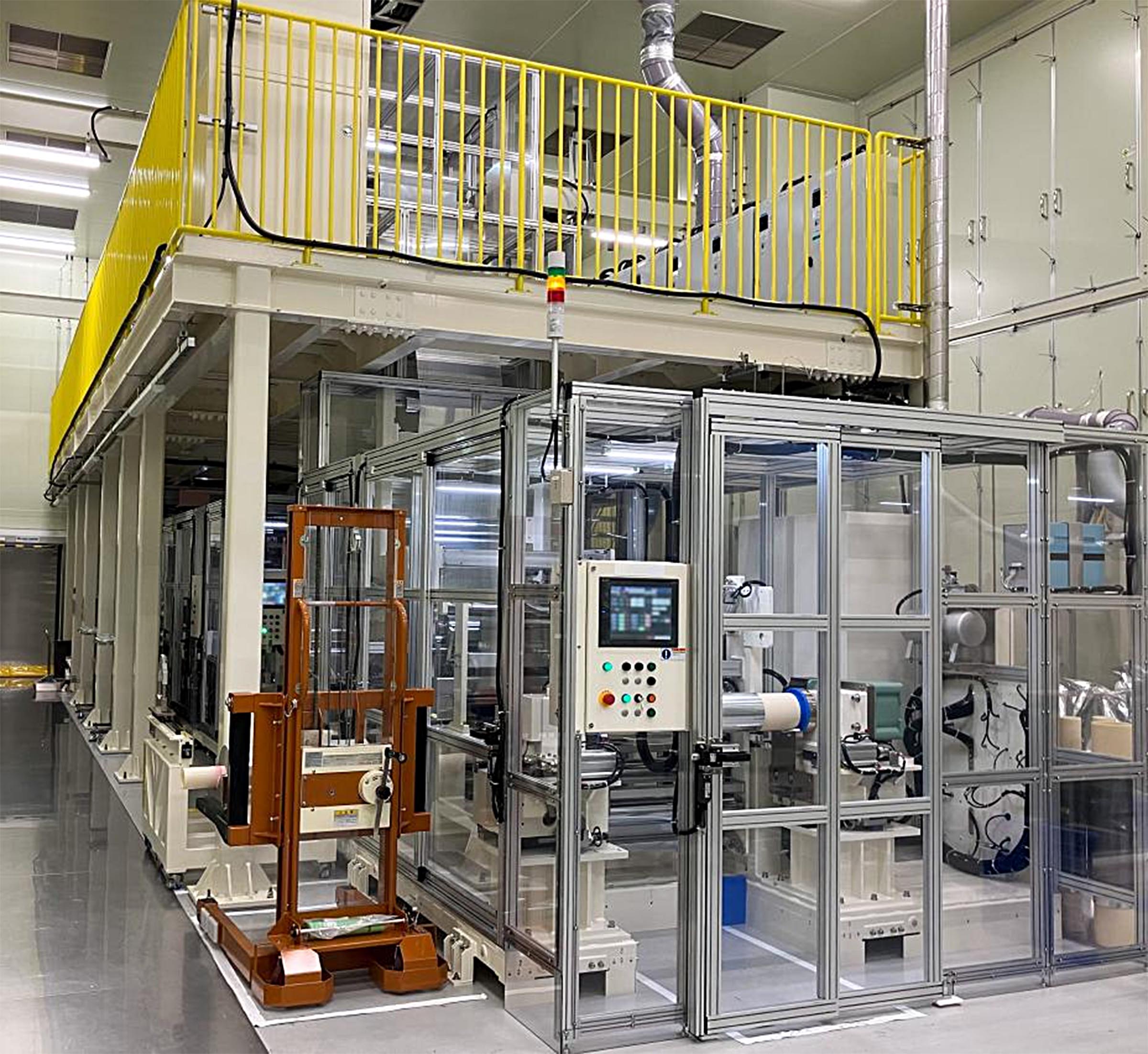
Honda has launched a prototype solid-state production line but doesn’t expect to see the technology go into commercial application until 2030.
Another plus: Donut Labs claims its battery manufacturing system is simpler and more forgiving than the rigorously controlled operation needed for lithium-ion cells which require the sort of clean-room processes used for modern semiconductors. That is another factor that will hold down production costs, said Piipo.
The company currently is operating a start-up facility that this year will have capacity to produce 1 gigawatt-hours’ worth of solid-state batteries. That would be enough to power up only around 30,000 Verge e-bikes or 10,000 to 12,000 of today’s typical battery-electric vehicles. But Donut is currently in A-round funding aimed at boosting capacity to 10 gWh next year, the executive said.
The company is already working with other clients including a British-based sports car manufacturer called Longbow, and Piipo cautiously suggested Donut may be in discussions with more established auto companies.
Other players set to follow
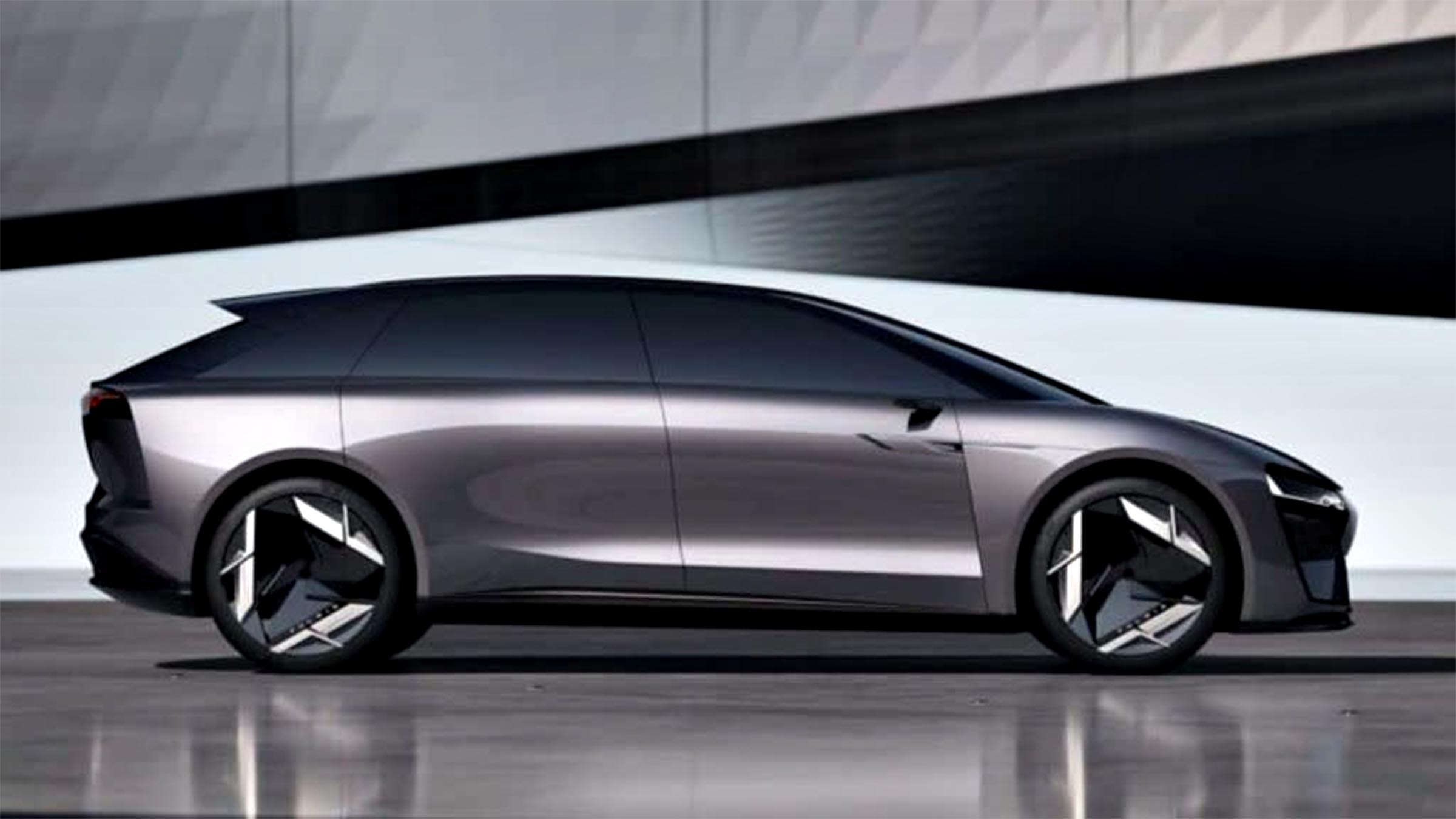
Chery’s solid-state EV concept.
The Estonian firm is by no means the only battery company working to move solid-state chemistry out of the lab and into commercial use – though Sam Abuelsamid, lead auto analyst with Telemetry Research, says there remains plenty of skepticism around technology that so far has proven far more difficult to commercialize than once anticipated. That’s been particularly challenging for batteries large enough for automotive applications, he said. Many automakers, including Ford and General Motors, are betting on not seeing a real breakthrough until decade’s end, at the earliest.
But they may soon be proven wrong. Domestic Chinese automaker Chery this week said it’s planning to roll out a solid-state-powered wagon later this year that will be able to deliver as much as 932 miles per charge. (That’s using the liberal Chinese test cycle and would likely come in somewhere between 600 and 700 miles in the U.S., though still well above what any EV can currently achieve.) Significantly, Chery said its battery technology offers “unmatched performance in sub-zero (Celsius) temperatures.” It plans to produce only a small number of the vehicles in 2026 for ride-sharing and rental applications.
Toyota, meanwhile, issued a statement last October announcing plans to begin low-volume production of solid-state vehicles in 2027 or 2028. The first application is expected to be a high-performance sports car.




0 Comments