
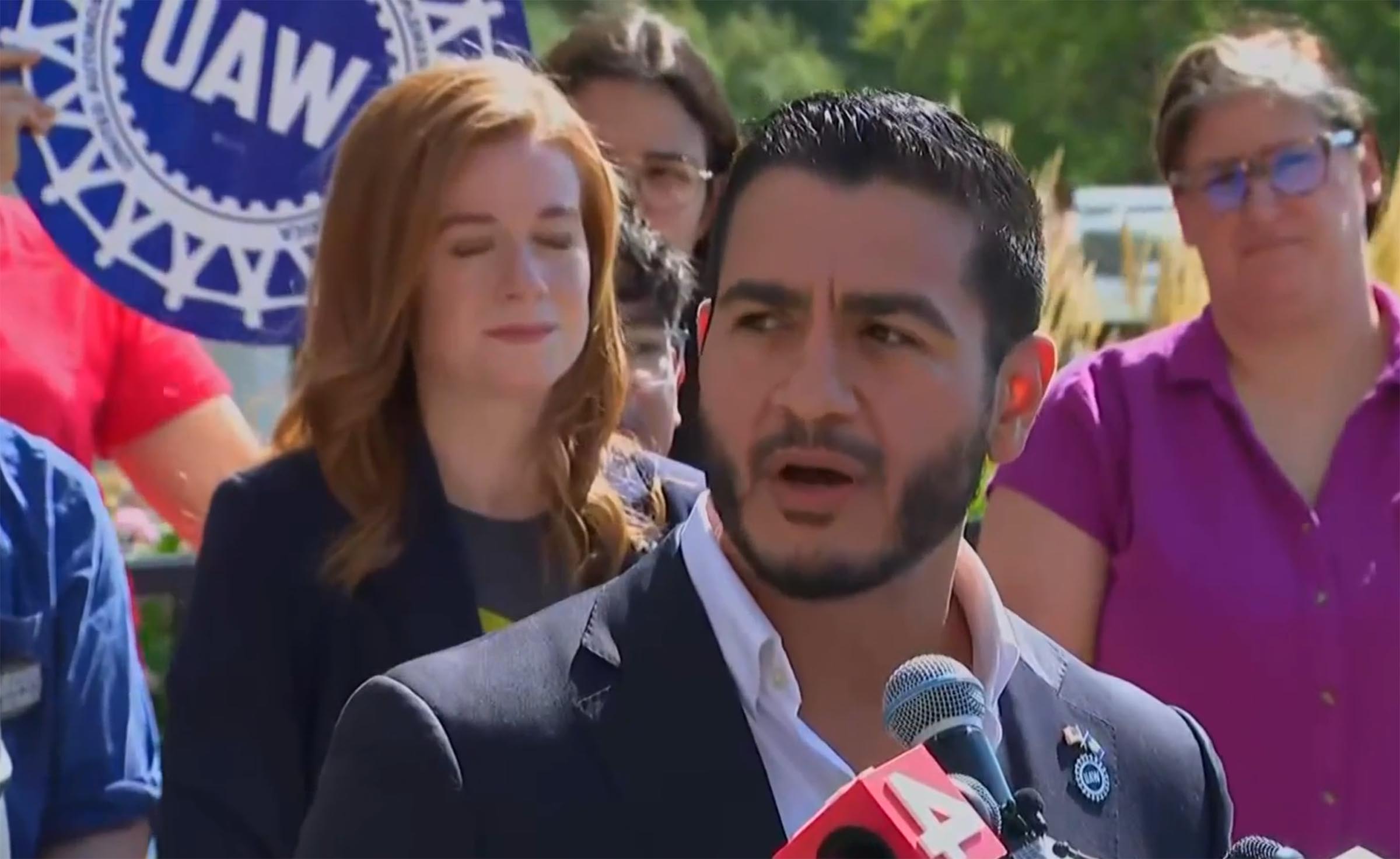
Abdul El Sayed narrowly won the Michigan Democratic primary for a seat in the U.S. Senate. But the United Auto Workers Union’s vocal support failed to persuade blue-collar workers living across the state’s big industrial base once also known as the Arsenal of Democracy..
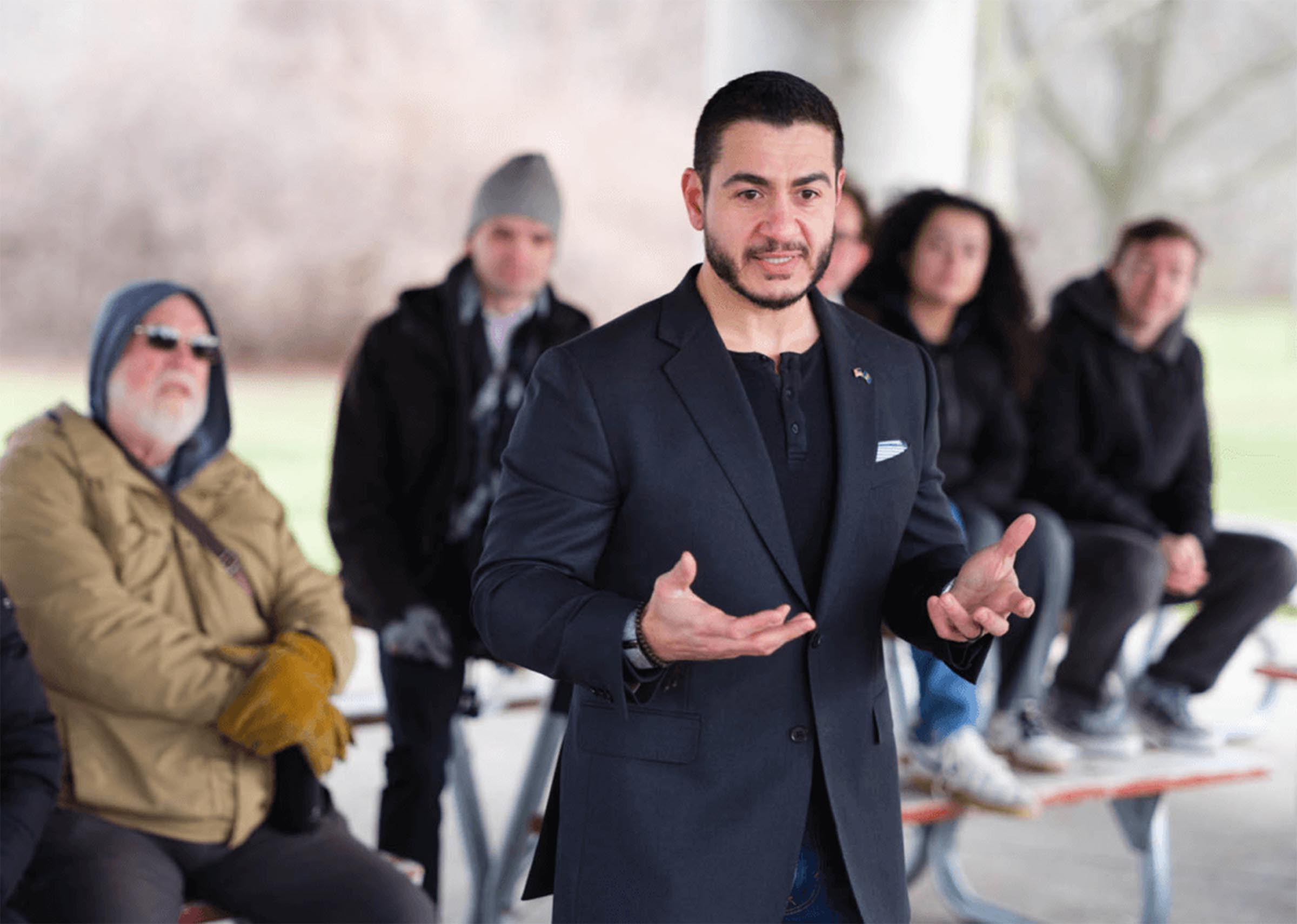
Candidate Abdul el-Sayed narrowly won the Michigan Democratic nomination.
The United Auto Workers is no stranger to politics.
But in the turbulent era spawned by the rise of Donald Trump, who was first elected with votes from disgruntled blue-collar workers, the UAW is finding it more difficult to fashion a political agenda with broad appeal to its membership, which now includes not only factory workers, but lawyers ,advanced researchers in health care, graduate students and public employees.
Meanwhile, UAW President Shawn Fain has hailed Trump’s tariffs even as he listens almost exclusively, according to critics, to a small circle of advisers tied closely to the Democratic Socialists of America.
The fault lines inside the UAW were on full display during the dramatic Democratic primary in Michigan, the union’s birthplace and where it has been a major influence for the better part of nine decades
Fain claims victory with El Sayed
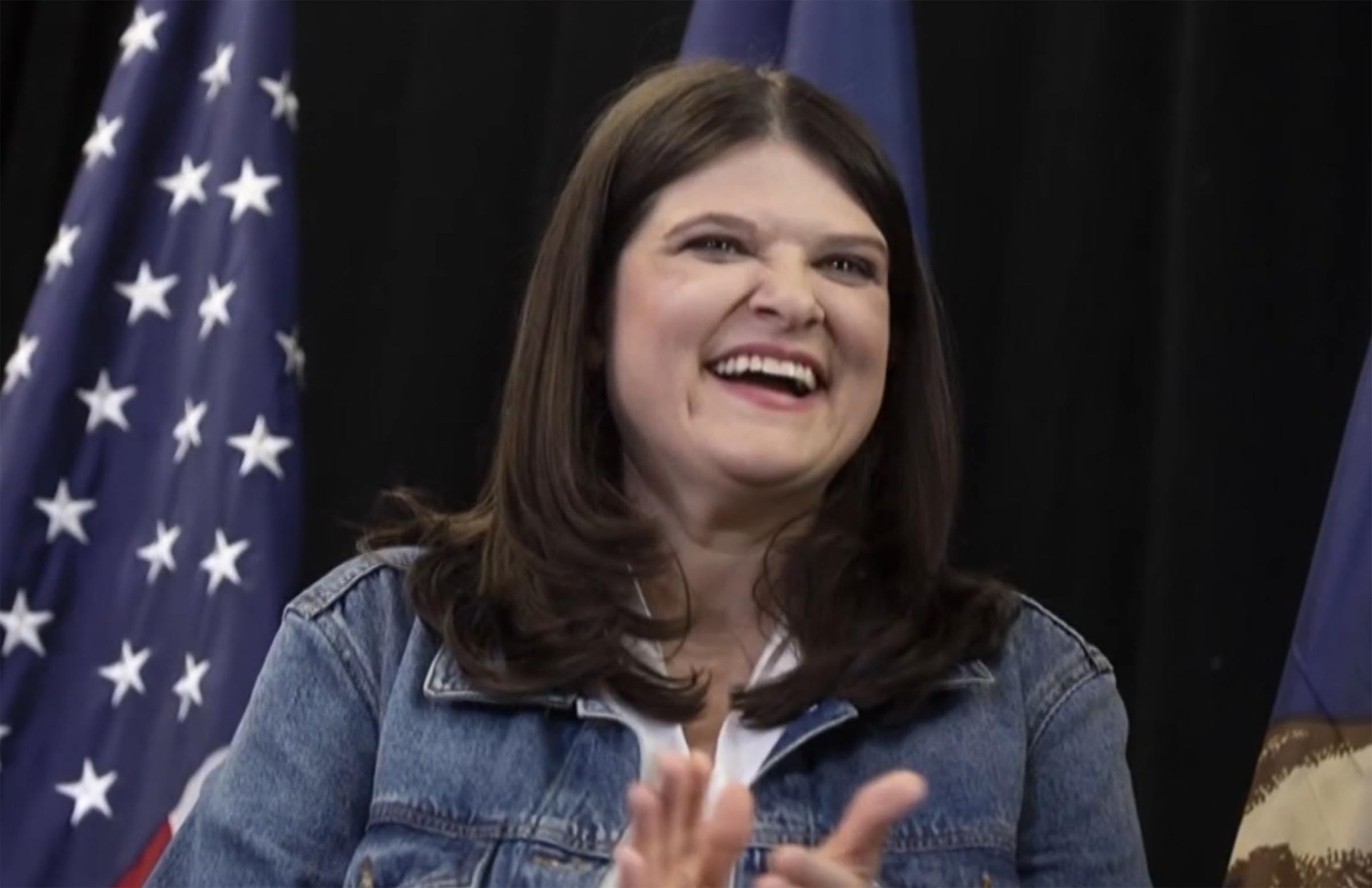
Haley Stevens took much of the blue-collar union vote despite the UAW’s endorsement of el-Sayed.
On the heels of Abdul El Sayed’s narrow victory over Rep. Haley Stevens in the Senatorial primary, Fain took a victory lap, despite vote totals, suggesting the union’s blue-collar membership is split between its conservative and liberal impulses.
“UAW members are done with business as usual in Michigan. The billionaire class thought they could buy another election,” said Fain, who like Trump, became famous for cursing at public events. “They underestimated the power of workers talking to workers. Shop floor conversations beat Wall Street’s checkbook. We backed Abdul because he answers to workers—not billionaires or corporate PACs,” added Fain, who also sports T-Shirts with slogans such as “Eat the Rich.”
Fain claimed 800 UAW members knocked on 15,000 doors, made more than 145,000 phone calls, and organized worker-to-worker conversations that helped turn out 112,887 UAW voters during Michigan’s early voting period. Member volunteers launched canvasses and phone banks in Detroit, Taylor, Warren, Flint, Saginaw, Lansing, Grand Rapids, Muskegon, and Three Rivers, demonstrating the strength of a statewide, member-led political operation.
Saginaw vote underscores union dissatisfaction
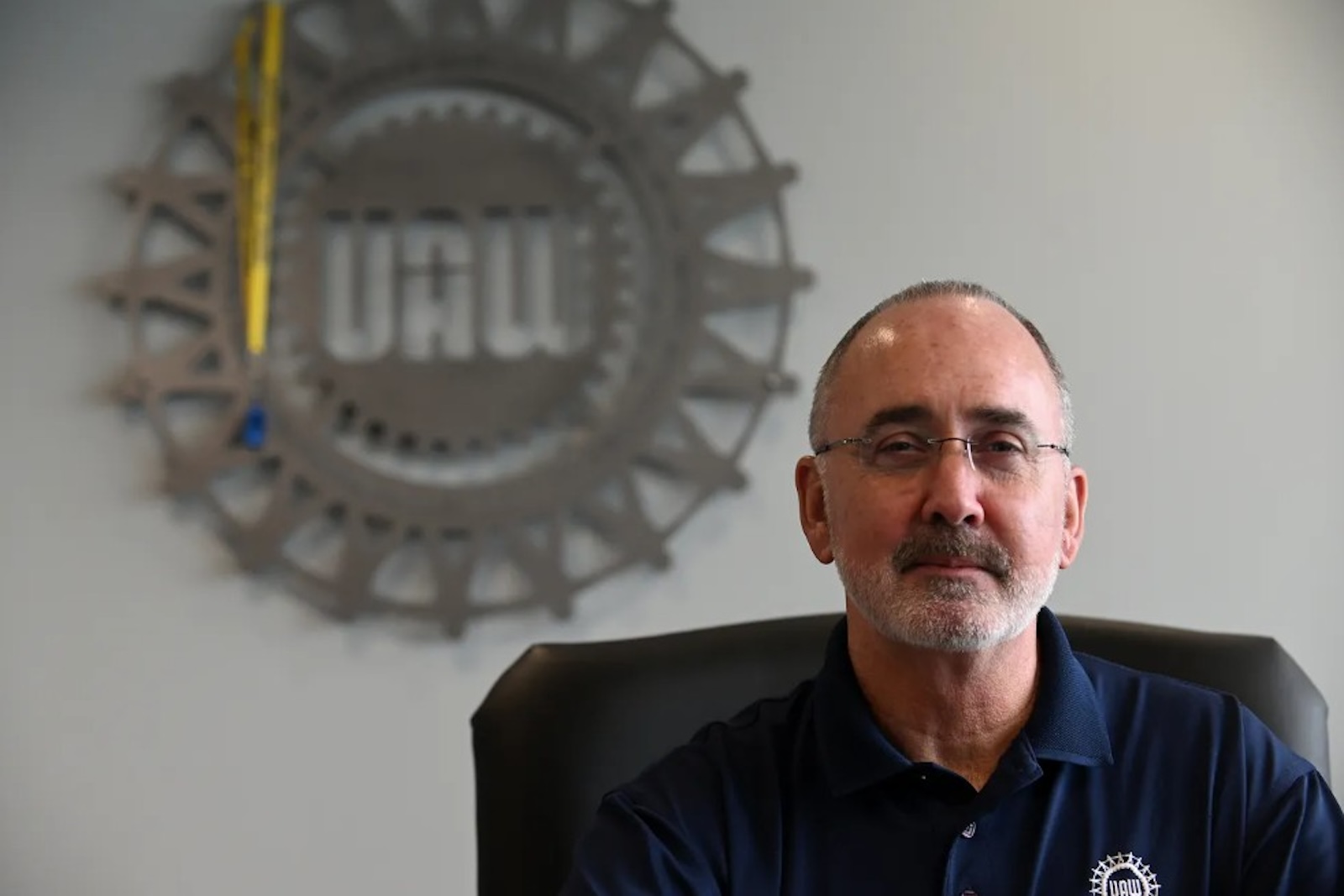
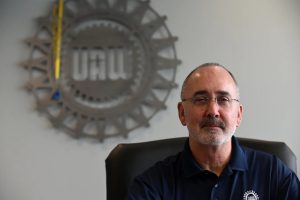
UAW President Shawn Fain.
Overall, in what is considered a good omen for Democrats in November, more than 500,000 more Michigan residents voted in the Democratic primary than in the Republican primary, which also featured a competitive race for the GOP nomination for governor.
But the election results from the Senate primary suggest the UAW endorsement fell short in key Blue-Collar counties along I-75 and in the City of Detroit where the union has long exerted influence.
For example, in Saginaw County, which is considered a key bellwether county and the home of a major automotive supplier linked to Detroit’s automakers, voters favored moderate Haley Stevens by 17 points 58% to 41%. The key is voters in and around Saginaw are sensitive to economic pressures having moved from Obama in 2008 and 2012 to Trump in 2016 to Biden in 2020 and back to Trump in 2024. In fact, Trump in 2024 carried Saginaw County by more than 3,000 votes/ However, Mike Rogers, the GOP’s candidate for the U.S.Senate then as he is now, lost to now Senator Elisa Slotkin in 2024 by a grand total of nine votes.
Additionally during the primary, El Sayed lost in Genesee County around Flint, which is the home base for more than 7,000 GM employees, the vast majority of whom belong to the UAW.
More Auto News
- Hybrids Charged Up July Auto Sales
- Has SRT Found the Answer to Turbo Lag?
- Dodge Debuts Charger Super Bee – But There’s More Coming
El Sayed also lost in Detroit
El Sayed’s problems with blue collar and UAW-oriented voters also showed up around Detroit. Vote totals from the August 4 primary also show El Sayed losing badly to Stevens in Macomb County, where the term Reagan Democrats was born and which is one of Michigan’s traditional battlegrounds as well as Fain’s home; and in the City of Detroit with its big majority of black voters.
In the city of Detroit, El Sayed lost to Stevens by nearly thirty points, underscoring his problems with black voters who could have been put off by comments from Hasan Piker, an big El Sayed supporter and a DSA influencer, who has boosted his career of insulting Jewish Americans and black Democrats also ran fifteen points behind Donovan McKinney, who ousted incumbent Shri Thanedar in an expensive primary battle for a seat in the U.?S. House of Representatives. McKinney, nominally a DSA candidate but, as Thanedar was quick to point out in his television ads, accepted huge campaign contributions from the pro-Trump Moroun family while serving in the Michigan legislature.
El Sayed, who in television interviews blamed the heavy dose of television advertising for his poor showing, also lost in Wayne County despite a record vote in the Muslim communities of Dearborn and Dearborn Heights were offset by from “downriver” with array of unionized blue-collar from the area’s array of steel, chemical and auto plants. The United Steel Workers had supported Stevens.
Dems still need big vote in Detroit suburbs
As they prepare for what could be a pivotal election in November, Democrats and the UAW also will have to repair the damage done to the Democratic coalition in suburban County where there are thousands of union members and retirees as well as thousand of college educated voters
Democratic success in statewide elections in Michigan for the past quarter century has rested on votes from the Oakland County suburbs northwest of Detroit, which offset the GOP advantages in the rural parts of the state.
El Sayed, however, lost Oakland County to Stevens during the August primary, and will have to find a way to motivate the coalition of Jewish and black voters, which has been critical to putting the county in the Democratic column In in the 21st Century.
Fain listens to small circle of left-leaning advisers
Meanwhile, Fain, who is amid his own re-election bid inside the UAW, has been chastised by critics for relying on a small circle of advisers as he makes political decisions for the union.
Support for tariffs and criticism of NAFTA have flourished inside and around the union for a long time. Hilary Clinton dropped her support for the so-called Transpacific Partnership after then UAW President Dennis Williams, under pressure from within the union, spoke out against the idea. But more recently Fain has been several louder about in support of Trump’s tariffs. At the same time, though, Fain has criticized Trump’s cuts to federal funding for scientific research, which are critical to the thousands of graduate students and researchers at places such as the National Institute of Health, which form a part of his electoral base inside the UAW as he campaigns for reelection to the union presidency.
A key part of Fain’s electoral base within the union is located not in the industrial Midwest but on the East Coast in what is known as UAW Region 9A, whose director Brandon Mancilla is tightly tied to the growing DSA political machine around and New York’s socialist Mayor Zohran Mamdani. As Fain brought in staffers from Bernie Sanders’ old campaign network to serve in key roles inside the union, often over criticism from long-time union staffers, Mancilla has emerged as the force dictating the union’s political direction.
Behind the conflict
The internal conflict, which revolves around a contract the Bernie Bros wanted placed with a firm with links to Sanders. Placement of the contract without bids, however, would have violated the rules imposed on the heels of the scandals, which rocked the union over the past decade. The matter triggered an investigation by the independent monitor, Neil Barofsky appointed on the heels of the scandal with the blessing of the reformers inside the union, who has referred the matter to a federal grand jury in Detroit. Fain now claims he is being persecuted because of the UAW’s – and the DSA’s’s – calls for an end to Israel’s war on Gaza. Fain also has claimed the charges result not from the facts but from Barofsky’s pro-Zionist leanings.
The internal conflict revolves around a contract the Bernie Bros wanted placed with a firm with links to Sanders. Placement of the contract without bids, however, would have violated the rules imposed on the heels of the scandals, which rocked the union over the past decade. The matter triggered an investigation by the independent monitor, Neil Barofsky appointed on the heels of the scandal with the blessing of the reformers inside the union, who has referred the matter to a federal grand jury in Detroit. Fain now claims he is being persecuted because of the UAW’s – and the DSA’s’s – calls for an end to Israel’s war on Gaza. Fain also has claimed the charges result not from the facts but from Barofsky’s pro-Zionist leanings.


0 Comments